
Back to Fats
Cholesterol is not a part of the core 3 nutrients listed above. It IS required for survival though. Cholesterol is a “sterol” compound, more closely related to lipids, or fats. They are large globular molecules that are constituent components in nearly every cell in the human body. They are also the primary source of all sex hormones (testosterone and estrogen), bile acid, steroid hormones (cortisol) as well as is necessary for the natural production of Vitamin D, within the skin.
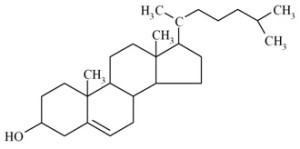
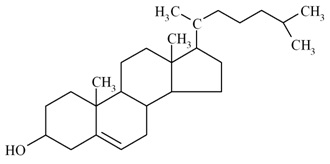
A Cholesterol Molecule
Cholesterol is derived from animal tissue and absorbed through the small intestine. Plants commonly have sterol compounds, similar to cholesterol, that compete with cholesterol absorption, thus lowering overall blood concentrations. Cholesterol is transported through the body by 2 different types of “lipo-proteins”. A lipo-protein is a compound with a fatty center, surrounded by protein shell, hence from where its name was derived. These compounds are known as LDL, or low density lipo-protein, and HDL, or High density lipo-protein. These two compounds serve completely different uses. LDLs or “bad cholesterol” take cholesterol from the intestine and deposit it within the body. It is believed that LDLs are the cause of diseases like arteriosclerosis, and cause events like myocardial infarction (Heart attack). HDLs take cholesterol from the tissues and transport it back to the liver to be broken down and excreted from the body. This is where the “good cholesterol” name comes from. Given these two mechanisms, it becomes clear why a high HDL count and a low LDL count are desirable. This will allow for most of the cholesterol in the body to be broken down, and store in body tissues. Cholesterol is important however. Without it, we would have debilitating consequences, as our cells would not maintain their structure well, and our bodies would not operate properly, with the absence of testosterone and estrogen.
The proper blood concentrations of cholesterol have not been effectively researched, as some people naturally have higher levels, with no consequences, where others have lower counts with drastic bodily repercussions. Most medical journals seem to agree that 200mg/dl is the “safe” number to be at, that is not too high and not too low, in terms of blood concentrations of cholesterol.
Cholesterol isn’t a substance that should be avoided at all costs, but should be consumed in moderation. Too much LDL is very bad for you, and too high of HDL levels, can also be bad, in the sense that HDLs can be “corrupted” by blood sugar, and will be deposited in the arteries like LDLs. This is why it is so crucial for a well rounded, healthy diet to be maintained. Even the beneficial parts of the body can become dysfunctional, when not moderated properly.
Authored by Christopher J. Herrington, DC 2014
Page updated 6/1/2014