The very idea of this article seems absurd, doesn’t it? How to sit? Who doesn’t know how to sit? You bend over, and put your butt onto something. It’s pretty easy, right?
What if I told you, most people sit improperly, and greatly increases your risk of back pain, due to improper muscular control from the ribs down to the toes, as well as prepares the upper body for added stress due to poor posture. Curious as to how that can possibly be? I’ll explain…
Pelvic tilting is the basis for most seated or lower body exercises. The unconscious ability to tilt our pelvis shifts the weight of the pelvis, minorly shifting the center of gravity, but also adjusting the body to brace for the movements that are about to occur.
Modern American living keeps raising the bar. By bar, I of course mean the height of where we sit. Chairs and toilets keep getting higher and higher. This actually has nothing to do with our height, it has more to do with our weight. Way back in the day, we used to sit/squat on the ground. Then chairs were invented, which made life a little easier, but we still had to lower ourselves into them. More time has passed, and our weight has slowly risen, along with our chair height. We’re slowly losing the ability to move our weight effectively, and as such, we’ve start buying higher chairs, so we don’t have to lower ourselves onto the seat, and more importantly get ourselves back off of the seat.
When we stopped lowering ourselves onto our seats, we slowly lost the ability to pelvic tilt; the core control to tilt our pelvis forward and backward. Many of us simply drop into the chair, with our lumbar spine curved backwards. We lean forward at the hips, flattening our backs and stick our butts out over the chair. This isn’t the proper way to sit, at all. This motion immediately reverses our lumbar lordosis, rolls our shoulders forward, and puts our head far out in front of our bodies. We’re already pre-conditioned to have poor sitting posture.
Pelvic Tilting
There are two directions the pelvis can tilt. A forward (anterior) pelvic tilt, which lengthens the abdominals, tenses the lumbar musculature, raises the back of the pelvis and via the “screw home mechanism” moves the knee inward slightly, rotates the lower leg and applies pressure to the inner foot, pushing the big toe into the ground harder.
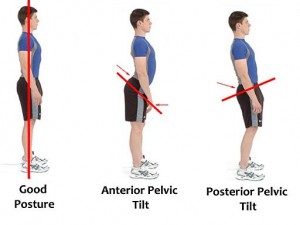
The other opposite direction is backward (posterior) pelvic tilt. This movement lowers the tailbone (coccyx) in a “tail tucking” manner, while flattening or curving the lumbar spine. The abdominals contract and the front of the pelvis is raised upward.
How to Sit
Step 1: Stand with the backs of the legs against the seat
Step 2: Anteriorly tilt the pelvis (arch your back)
Step 3: Lower yourself with your knees, until your buttocks is resting on the chair, with your back straight.
This posture naturally sits you down, with your spine straight, shoulders back and head directly over your shoulders.
How poor sitting posture affects you
First and foremost, the slumped forward posture is going to affect your joints and muscles.
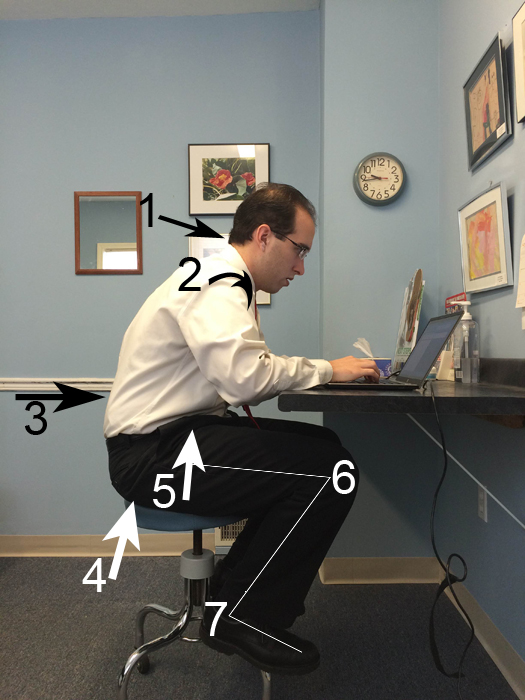
These are the joint related problems with the picture above
1) The head is forward from the body, and neck is flexed to look up at the screen.
2) Shoulders are rounded forward, and shoulder blades are pulled apart
3) No curve in the lower back
4) The pelvis is tipped forward, contracting the hamstrings
5) Abdomen is relaxed and weak, with the hips at an acute angle
6) Knees are bent at an acute angle
7) Ankle is bent at an acute angle.
This is simply a summary of the viewpoint of the joint problems. Given this posture, there are several bodily systems that can be affected:
Let’s start at the top
The position of the head is causing the scalene muscles (support muscles of the neck) to be forced to hold the head away from the body. Anyone who has held a weight at full arms length away from their body can tell you that this is MUCH harder than holding a weight close to the body. These muscles will become tight, contracted and inflamed, which will cause a lack of mobility of the neck, side to side.
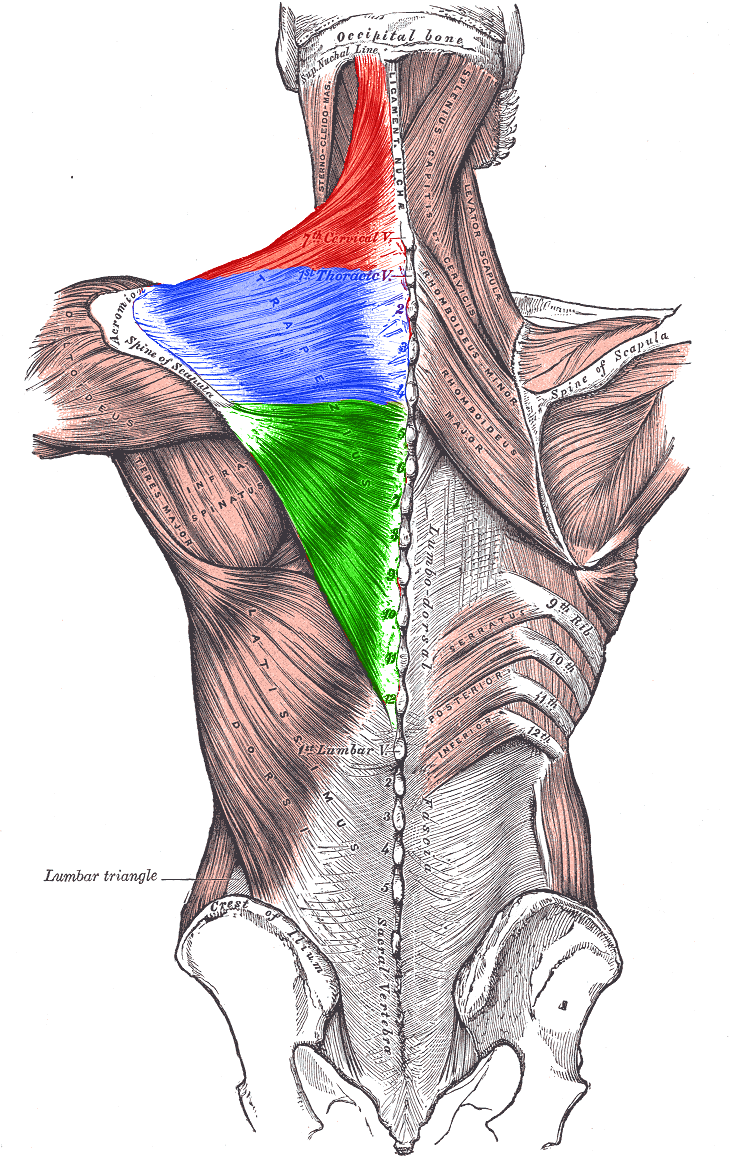 The trapezius (large primary moving muscle of the back and shoulders) has 3 primary sections, the upper, middle and lower. These are shown to the left, the upper is colored red, middle in blue, lower in green. The upper section is on the back of the neck; the middle is across the shoulders and lower is between the scapulae (shoulder blades). The upper and middle will be contracted and shortened, while the lower will be stretched and weakened. The tightness in the upper trapezius will reflexively inhibit the deeper neck muscles (prevent them from working). This inhibition will cause the smaller muscles of the upper neck to have to work harder to maintain that head posture. These smaller muscles (sub occipital muscles), are meant to be used for minor, smooth, controlled movements of the head, not for assisting in the flexion of the head on the spine. These muscles easily become hypertonic (contracted and inflamed) which quite often leads to headaches.
The lower trapezius is meant to counteract the pectoralis major. These muscles retract the scapulae back to where they belong, in a resting position, while seated or standing. If they are weak and overstretched, they are unable to do this, which will perpetuate a poor seated posture. This weakening makes it harder and harder to keep the shoulders in their proper “back and down” position.
The levator scapulae, is another muscle that is getting abused in this position. This muscle is shown below, highlighted below, in red. The scapulae are suppose to rest in a “back and down” position. This lengthens the levator scapulae, allowing it to sit loose and relaxed. This muscle attaches to the base of the skull, and the inner most tip of the shoulder blade. This point is commonly known by post people at the tight, hard, painful point just under the base of the neck. Due to excessive sitting, most people have a trigger point at this muscles insertion. This muscle, along with the trapezius, is a common cause of myofascial irritation, which can cause a variety of tension headaches, known as the Question Mark headache. The pain travels around the ear, down the neck, skips a small section at the base of the neck and ends in a tender point in the back. This path is the pain referral pattern of the suboccipital muscles, trapezius and levator scapulae muscles.
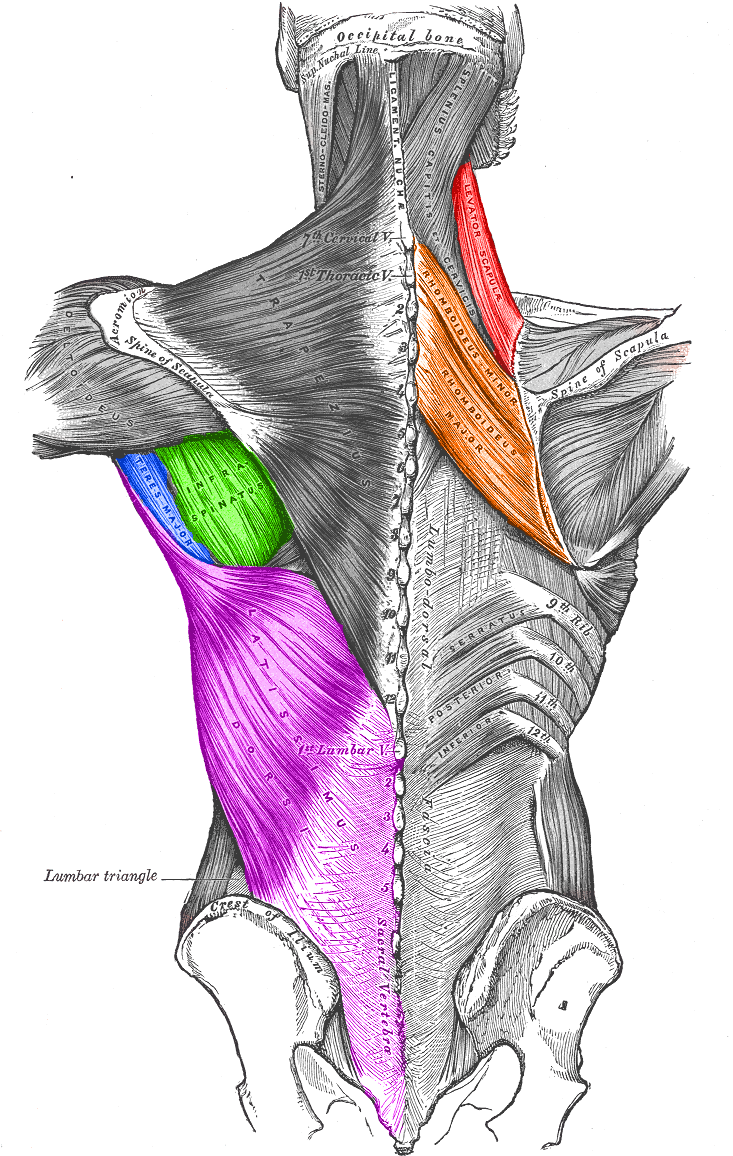 This poor mobility of the scapula, with the seated position of the shoulders rolled up and forward, will also cause the inferior muscles of the shoulder (teres major, subscapularis, infraspinatus, and latissimus dorsi) to also become increasingly hypertonic in their attachments at the humerus (arm). These muscles are shown to the left; infraspinatus is highlighted green, teres major in blue, latissimus dorsi in purple. The subscapularis cannot be seen, as it is situated between the ribs and the back of the scapula. All of these muscles attach, in and around the same regions in the arm, which are also located very close to the nerves travelling down from the neck, to the hand. When these muscles and tendons inflame, they can cause possible irritation of the nerves from the neck, which can mimic symptoms of carpal tunnel and therefore directly cause a weakening of the muscles in the forearm (grip strength).
While the scapulae are protracted and raised, the rhomboid muscles (major and minor) also become very weak. These muscles are highlighted above, in orange. These two muscles are located directly under the middle and lower trapezius and function in the exact same way as the lower trapezius. They are simply thin, weak muscles that are meant to pull the shoulder blade back to its original location.
The pectoralis major is meant to rotate the shoulder inward, and push outward. In this seated position, the pectoralis is contracted and tight. The pectoralis minor is located directly beneath pectoralis major, and its sole responsibility is to pull the scapula outward (protraction). Without even knowing it, seated in this posture, pectoralis major is holding your shoulders forward, and pectoralis minor is pulling your scapula’s apart. This won’t cause any discomfort on its own, but it leads to poor motor function of the shoulder. Proper movement of the scapula cannot be obtained with the biggest strongest muscle of the chest, overpowering the retraction of the shoulders. (The pectoralis major upper arm to the chest, while minor attaches from the chest to the scapula) There isn’t any direct contact with the shoulder, from pectoralis major, but its postural affects on the chest directly influence the posterior muscles of the back and consequentially, the shoulder) the other effects of pectoralis hypertonicity are via indirect inflammation. The tendon of the pectoralis major, traveling from the chest to the humerus (arm), and pectoralis minor from the chest to the coracoid process of the scapula (boney projection on the front of the shoulder) when under enough stress and tension, become very rigid, tight, and less mobile. This causes the fibers of these two muscles and tendons to become inflamed, which in turn, will inflame other tissues in the area. The largest problem with this is that the nerves that travel down the arm travel directly under the tendons of these two muscles, as they attach to the shoulder.
The forward flexed posture of the mid back (thoracic) and low back (lumbar) regions, also compresses the rib cage. This reduces the space it has to expand, thus reducing the ability to breath. This isn’t a problem with seated posture, as most people typically don’t breathe heavily while seated, but if this posture was maintained while standing, then complications could result.
Sitting in this manner also reduces the ability of the diaphragm to extend. Regular shallow breathing should be achieved by pushing the stomach outwards, which extends the diaphragm, expanding the lung space and pulling air in through the mouth/nose. Breathing with your shoulders, is possible, but using your upper shoulder muscles to pull your ribcage up, against gravity, will eventually lead to more strain on the muscles that area already having a hard time coping with the position of your head. Over time, the scalene, serratus anterior, trapezius and levator scapulae will become even more hypertonic and lead to even more headaches, neck, shoulder and arm pain.
How to Correct this Poor Upper Posture
The first step, is to start to stretch. The chest, neck and shoulders need to be “opened up”. This means the shoulders and head need to be retracted (moved backward) and the chest needs to be pushed forward. This stretches the pectoralis, SCM, scaleni, and contracts the middle/lower trapezius, rhomboids, levator scapulae, teres major, infraspinatus and subscapularis. This simple stretch doesn’t reverse the poor posture, but it’s the most basic stretch that can be accomplished. Further steps include more specific stretching of each individual muscle, joint mobilization of the spine, shoulder, clavicles and sternum (if restrictions exist), identification of weak muscles and functional restoration movement through rehabilitory exercises. This whole process takes upwards of 8 weeks to accomplish, with daily at home exercises.
How Seated Posture affects the Lower Body
While discussing the slumped posture, it is hard to ignore the effect on the abdominal region. From a muscular/structural standpoint, we’re compressing the abdominals, keeping our knees close to our chest. One of the biggest advantages of being a two legged walker is that we have very powerful legs that can carry us very long distances. These large powerful muscles are situated in the hips, gluteals, and thighs. The hip muscles are used for bringing our knees forward, forcefully to take long strides. The gluteals extend our legs for a powerful push off, and the thighs swing the lower leg forward to dig into the ground for the next step.
Seated in such a way reverses all of those functions. The hip flexors (raise the knee to the chest) are short and tight, holding the weight of the all of the body existing above the waist. The gluteal muscles are extended and weak. This is one of the largest, most powerful muscles of the body, and its completely inhibited by the activity of the hip flexors. The quadriceps (whose primary job is the extension of the knee) is completely inhibited by the activity of the hamstrings (whose primary job is to flex the knee). With the body leaned forward and the knees bent in such a way, every natural advantage of our amazing bodies, is completely reversed. Powerful muscles are unable to work and their weaker counterparts are forced to hold the weight of the body, a job for which they were not meant.
This reversal of functions causes much more problems than initially thought. Most adults cannot squat properly. This action is one of the most fundamental to our general being. It is demonstrated with expert proficiency by babies, with barely enough coordination to walk. Babies are the squatting masters. No-one teaches them how to, they just do it naturally. Any parent can tell you, they’ve seen their kid squat. Whether it’s to get lower to the ground to play with a toy, or because they are filling their diaper, they have perfect squat form, which requires pelvic tilting and proper muscle coordination of nearly all the muscles from the feet to the chest in order to accomplish.
These are the common occurrences of improper squatting
If the muscles of the anterior or posterior lower leg are too tight and sore, you’ll lean too far forward, or can’t drop down properly, at the ankle. If the muscles of the quadriceps are too short and tight, you won’t be able to properly flex the knee. The muscles of the inside and outside of the thigh are also crucially important. If they are too tight or too weak, a proper squat cannot be achieved. The thigh and knee will migrate inward or outward as the pelvis drops into the squatted position. If the hip flexors are too tight, you’ll flex forward too soon, which will prevent the lower back from arching properly, and the knee from flexing properly. If the muscles are too weak, you won’t be able to drop down far enough. If the lower back, or abdominals are too weak, you won’t be able to brace properly to be able to maintain balance. Lastly, and most importantly, if the abdominal tissue is too prominent, then you won’t be able to flex forward or drop down far enough, due to space limitations between the gut and the ribcage.
Why is squatting so important?
This is one of the most complex, yet most basic movements of human living. We’ve all but “modernized” away from this action though. Nearly all major muscle groups are required to do this motion, and yet babies are able to accomplish it without a second thought. There are a large number of complications that can result of having poor squatting form, or a straight inability.
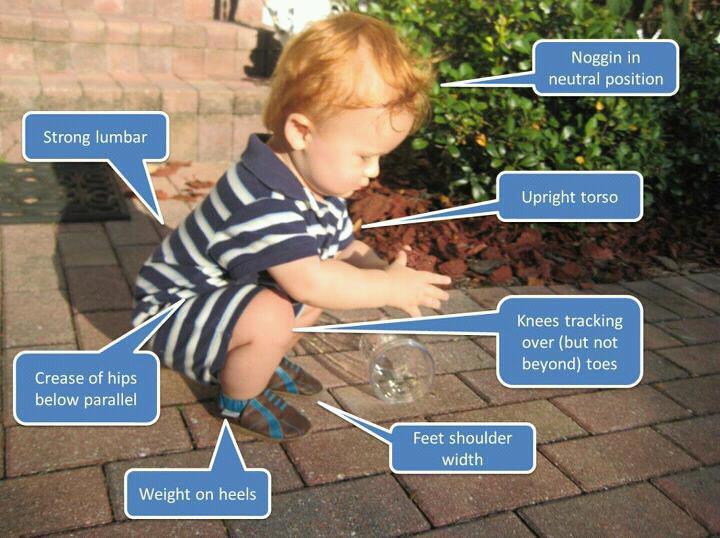
Movement coordination suffers, due to poor core control based around the abdominals and the lumbar spine. This lack of control causes the entire body to be off balance, as this “core” is the center for our upright stability. As core stability and coordination degrades the risk of falling increases, as well as the risk of injuries.
An inability to stand up, from sitting, without the use of a person’s hands, has been shown to relate to an increase of all cause mortality.
“Over the study period 159 subjects died a mortality rate of 7.9%. The majority of these deaths occurred in people with low test scores — indeed, only two of the deaths were in subjects who gained a composite score of 10. Analysis found that survival in each of the four categories differed with high statistical significance. These differences persisted when results were controlled for age, gender and body mass index, suggesting that the sitting-rising test score is a significant predictor of all-cause mortality; indeed, subjects in the lower score range (C1) had a 5-6 times higher risk of death than those in the reference group (C4).” [1]
This idea might be extreme to some, but general aerobic functionality, is one of the prime benefits of being a human being. We are supposed to be strong and active individuals.
Another unspoken problem with poor squatting ability is the ability to properly remove waste from the body. Evacuation of the bowels, again, as demonstrated by babies, is pretty basic. You don’t teach a child how to, it’s a natural function. As people got larger, and were unable to squat lower, due to poor muscle control, toilets became higher. As toilets became higher, the incidence of hemorrhoids also increased. While these two problems may seem to be unrelated or coincidental, studies have been conducted that show the more upright a person sits, the more strain is required to properly accomplish a bowel movement[2]. The more strain that is required, the more “intrathecal” pressure is exerted. The more pressure that is applied from within the body, the more the likelihood of that pressure causing some kind of internal injury. This pressure can be replicated by a technique known as the Valsalva maneuver, which is a very effective test for vertebral disc injuries. By increasing pressure within the body, this pressure applies from the inside out, increasing tension on all tissues.
These are just some of the complications from poor posture, as well as the benefits of sitting correctly. If you’ve read through this article and said, even once, “that sounds like me”, then you should contact my office and set up an appointment. The path to a better you is available.
[1]European Society of Cardiology. (2012, December 13). Ability to sit and rise from the floor is closely correlated with all-cause mortality risk. ScienceDaily. Retrieved December 15, 2014 from www.sciencedaily.com/releases/2012/12/121213085202.htm
[2]Sikirov, D. (n.d.). Comparison of Straining During Defecation in Three Positions: Results and Implications for Human Health. Digestive Diseases and Sciences, 48(7), 1201-1205. Retrieved from http://link.springer.com/article/10.1023/A:1024180319005