
Back to Proteins
Fats are much more complicated to explain, than the previous two nutritional types. Fat is an essential nutrient for human life, but there are different types of fats, which are treated differently in the body. They are composed of fatty acids, which are chains of carbons, hydrogens and oxygens. The length of the fatty acid chain varies, as well as the number of molecular bonds (the connections that hold the atoms together), which is what alters how the body treats each specific fatty acid. If a double bond is present, then the fatty acid is known as unsaturated. If there is not one present, it is known as saturated. There is a much easier way to recognize this state of saturated versus unsaturated. If the oil is solid at room temperature, its saturated, if it’s liquid, then it’s unsaturated. The general rule of thumb is that saturated fat is bad for you, and unsaturated is good for you.
However, recent studies have discovered that coconut oil, is almost entirely saturated fat, and is exceptionally healthy. Steric acid, a saturated fat commonly found in beef, has shown excellent anti-inflammatory properties. These previous beliefs as to what fat is “good” and what is “bad” don’t hold true 100% of the time, as current knowledge expands about human nutrition. Animal fat is typically more commonly saturated, and vegetable fat is most commonly unsaturated, hence where these old beliefs of what is “good” and “bad” have come from.
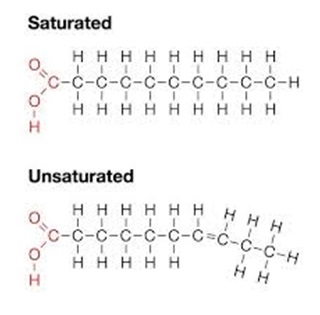
Fatty acid comparisons
As previously stated, the length of the chain, and number of double bonds, make the largest difference on quality of the fat. A mono-unsaturated fatty acids (MUFAs), which is a fatty acid with only one double bond, are known as Oleic fats, are the most critical fat for the human body. These fats are commonly referred to as Omega 9 fatty acids. Nutritional equivalents for these fats are olive oil and peanut oil. These are not essential fats. The body can break apart other fatty acid chains to produce this kind of fat, thus making this not essential to human nutrition. In contrast, Omega 3 and Omega 6 fatty acids, also known as poly-unsaturated fatty acids (PUFAs) are essential, as they cannot be created within the body.
Fatty acids do appear in foods, as singular fatty acids, but they are most commonly presented in triglycerides. A triglyceride is a glycerol molecule, with 3 fatty acids attached. These molecules can be digested into its constituent parts.
Trans-fats are the current front runner for the worst fats available for consumption. These are commonly created by heating or reheating fats/oils for cooking purposes. The name comes from their chemical “trans” formation. Depending on how certain molecules form, they have either a “cis” formation, or a “trans” formation. “Cis” presentations do not allow the fats to stack well. Imagine a large pile of tree branches thrown together. There’s space between them, they are not neatly piled. However, if you break all the side branches off, and just have straight sticks, they do fit together nicely, and will lay flat. This is how trans-fats present in the body; they are tightly packed, and easily deposited in body tissues. Digestion of trans-fats has been shown to lower HDL counts and raise LDL counts of cholesterol in the body. The process by which this happens isn’t well understood yet, but research has shown a correlation between the two.
These compounds are known as LDL, or low density lipo-protein, and HDL, or High density lipo-protein. These two compounds serve completely different uses. LDLs or “bad cholesterol” take cholesterol from the intestine and deposit it within the body. It is believed that LDLs are the cause of diseases like arteriosclerosis, and cause events like myocardial infarction (Heart attack). HDLs take cholesterol from the tissues and transport it back to the liver to be broken down and excreted from the body. This is where the “good cholesterol” name comes from. Given these two mechanisms, it becomes clear why a high HDL count and a low LDL count are desirable.
Hydrogenation process converts unsaturated fatty acids to saturated fat, by adding a hydrogen molecule to the fat chain (breaking the aforementioned double bond). This increases the melting point of the fat (keeping it solid at room temperature and less likely to spoil). The downside to this process is that any beneficial parts of the fat are destroyed. Partially hydrogenated oils are commonly used in baked goods, shortening and fried foods. Foods containing this kind of product should be avoided. Fully hydrogenated are not as bad for the human body as the partial variety, but hydrogenation as a whole, is less healthy than naturally occurring fats.
Proceed to Cholesterol
Authored by Christopher J. Herrington, DC 2014
Page updated 6/1/2014
Information retrieved from:
Katsilambros, N. (2010). Clinical nutrition in practice. Chichester, West Sussex, U.K.: Wiley-Blackwell.
Rolfes, S. R., & Pinna, K. (2009). Understanding normal and clinical nutrition (8th ed.). Belmont, CA: Wadsworth/Cengage Learning.
Wardlaw, G. M., & Smith, A. M. (2007). Contemporary nutrition (6th ed.). Boston: McGraw-Hill Higher Education.