
Back to Carbohydrates
Proteins are the building blocks of the body. Humans are composed of organs, which are composed of cells, which are composed of organelles, which are composed of amino acids, which are composed of molecules, which are composed of atoms. The smallest piece of a protein structure is known as an amino acid. Tens, to tens of thousands of amino acids can link together to form a singular protein. When digested, amino acids yield 7 Calories per gram. They are the only source of nitrogen for the body. Nearly every cell of the human body has a revolving “replacement” time period. Some cells are replaced as infrequently as 90 days (blood cells), where some structures (such as bones) get remodeled every couple years. Each individual cell requires amino acids to be placed in very particular ways to duplicate their functional parts, known as organelles. Essentially, a cell duplicates all its parts, splits off into 2 separate cells, and then the older version is absorbed back into the body to be digested. In order for this whole process to take place, the human body needs a constant source of protein to keep up with the remodeling and upkeep of its cells. This also applies for any damage sustained to the skin, muscles or other tissues of the body. Damaged cells are destroyed and absorbed, as new cells are re-grown and replaced. The average adult human needs approximately 0.5g-0.7g of protein, per kg of body weight, per day, in order to sustain proper health.
Now, with that being said, not all protein comes from animals. Some plants yield just as much protein per serving, as many animal products. Amino acids are not exclusive to animals.
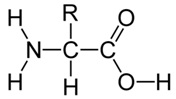
The basic animo acid form
The “R” in the image above is the only group that changes, in an amino acid. There are 21 different amino acids, 9 of which are essential, meaning the body cannot produce them on its own, and they must be consumed. These 21 amino acids are rearranged into different ordered chains, to form different hormones, cellular organelles, enzymes; all viable structures within the body.
Proceed to Fats
Authored by Christopher J. Herrington, DC 2014
Page updated 6/1/2014
Information retrieved from:
Katsilambros, N. (2010). Clinical nutrition in practice. Chichester, West Sussex, U.K.: Wiley-Blackwell.
Rolfes, S. R., & Pinna, K. (2009). Understanding normal and clinical nutrition (8th ed.). Belmont, CA: Wadsworth/Cengage Learning.
Wardlaw, G. M., & Smith, A. M. (2007). Contemporary nutrition (6th ed.). Boston: McGraw-Hill Higher Education.